BLeed
When the game has started you will be portraying a character for at least the duration of the in-game sessions. You will move, speak, act and often feel like your character would. When you choose your playing style, keep in mind that you may spend hours inhabiting them, and that you will likely experience some bleed. For participants new to LARP who may not be aware of bleed this page exists to familiarise you with the concept and provide you with tools to manage your experience such that it does not become overwhelming.
Explaining Bleed
When we enter the game from the outside, we adopt a new set of social rules, both implicit and explicit. These social rules function on an in-character level, e.g., this airbnb is actually the heart of a frozen city; when a character slashes the air in front of you, it symbolizes a stabbing; when a player speaks, they are portraying a medical doctor, not their real world profession.
Out-of-game social rules also apply, we will stay in-character for the duration of the experience; we will avoid touching without permission; we will observe safe words when used, and so on. Collectively, these rules make up the social contract of the game.
When the social contract is established, players can safely enter the magic circle, a poetic term describing the rules, identities, and occurrences within the game space.
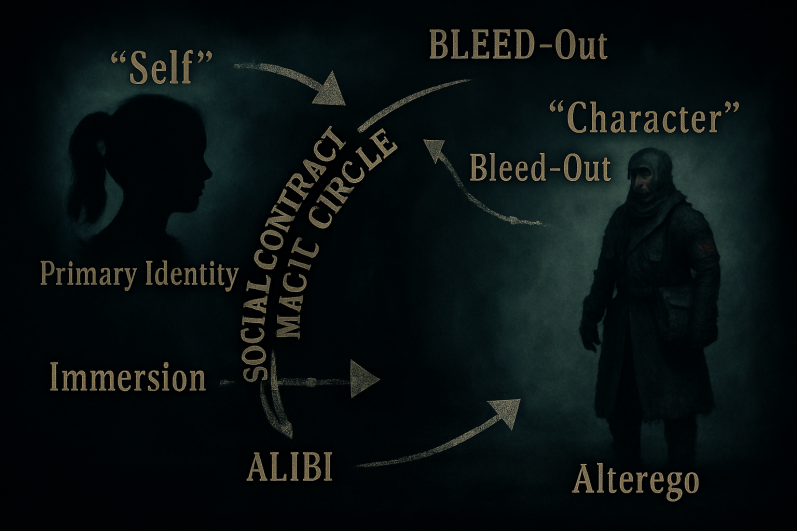
Perhaps the most important facet of the social contract is the alibi, in which players accept the premise that any actions in the game are taken by the character, not by the player. Phrases like, “It wasn’t me, it was my character” and “It’s what my character would have done” are a direct result of the benefit of alibi. In principle, no individual is responsible for their actions in-character if those events could unfold plausibly within the fiction.
Alibi has a direct correlation with bleed: the stronger the alibi, the weaker the bleed. Alternately, playing close to home provides an inherently weaker alibi. For example, if a player has children in real life, playing a parent in a game will likely produce greater bleed and lesser alibi. The player might strengthen the alibi by establishing very different relationship dynamics between the character and the fictional children, thereby affording added distance. Alternately, the player can choose to push toward a greater degree of bleed by using the real names of his or her real life children in-game.
None of these choices will ensure the participant will experience greater or lesser bleed, however. Bleed is not a factor players can necessarily control. In fact, bleed is largely an unconscious process when it occurs, whereas a conscious choice on the part of the player to alter the course of the character is known as steering. Therefore, a player can steer toward greater bleed by pushing factors that are likely to cause a bleed response, but bleed is not guaranteed. Alternately, players can steer away from potentially emotionally impacting factors, but end up affected by them nonetheless.
It’s important to mention that bleed is neither an inherently negative nor positive phenomenon. Some players erect strong mental boundaries between themselves and their characters in order to avoid bleed. Others consciously seek bleed experiences by “playing close to home.” As this will be the first time LARPing for the majority of the participants, we would encourage players to try and steer away from consciously seeking intense bleed experiences and potentially overwhelming newer players who may be uncomfortable when confronted with this phenomenon for the first time.
Explaining the phenomenon of bleed first requires establishing some basic vocabulary to help understand the role-playing experience as a whole.
Bleed comes in two major forms: bleed-in – when the emotions, thoughts, relationship dynamics, and physical states of the player affect the character – and bleed-out, the opposite process. A bleed feedback loop is also observable, when it becomes difficult to tell where the player begins and the character ends, especially in emotionally overwhelming situations.
This phenomenon does not mean that the player is incapable of upholding the magic circle, but rather that the intensity of emotion has become overwhelming to the mind, causing confusion and difficulties with immediate processing and distancing.
Types of Bleed

Bleed is most often described in terms of emotional experiences, as emotions are the least conscious and most spontaneous aspects of enactment. However, other factors are connected with emotional reactions. Out-of-game thoughts are often interwoven with emotional responses, e.g. “I can’t believe Johnny is insulting my character. He always acts this way when we play together,” which may later induce an angry outburst in-character. Also, relationship dynamics can affect bleed. If two players are best friends out-of-game, they may unconsciously replicate that dynamic within the magic circle.
Another type of bleed is termed ego bleed. This occurs when the contents of the player’s personality spillover into the character’s, and vice versa. This effect is most measurable when players claim to have learned skills from their in-game experiences that become useful in reality, such as leadership, seduction, etc. However, prolonged immersion into antisocial characteristics such as violent plotting and social backstabbing may impact negatively the participants’ personalities, affecting their relationships with other players out-of-game.
At its most positive, bleed experiences can produce moments of catharsis: when the player and character emotions are synced in a powerful moment of emotional expression. Most often, these experiences manifest in great displays of joy, love, anger, or grief; in-game crying is often associated with bleed. Regardless of their original intentions for alibi, players often call these cathartic experiences their Golden Moments, perhaps because the alibi of the game is still strong enough to allow them the opportunity to express emotions they might otherwise feel inhibited to share in real life.
However, not all bleed experiences are considered positive. Players may, for example, feel lasting aggression toward someone who acted antagonistically toward their character in-game. Such feelings may do damage to their out-of-game relationships. Intimate love connections can also form in games as the result of bleed. While some of these relationships may translate well to the outside world, in-game relationships also run the risk of damaging existing intimate bonds by complicating established boundaries or invoking jealousy.
Strategies to Manage bleed
Whether or not participants intend to play for bleed, the impact of bleed experiences can become quite intense for some individuals. You as a player might maintain a strong distance between self and character, and this may leave you feeling mystified when another participant feels long-lasting emotional devastation at the loss of an in-game companion, for example. Always remember the LARP golden rules and acknowledge that the perspective of other players are equally as valid as your own.
Remember to make liberal use of the safety tools advertised to help communicate with one another if you are either experiencing overwhelming bleed, or suspect another’s bleed has become too intense. Opting-out of a scene at any time is always acceptable, and you should never feel pressured to continue in order to avoid “ruining” the game for others.
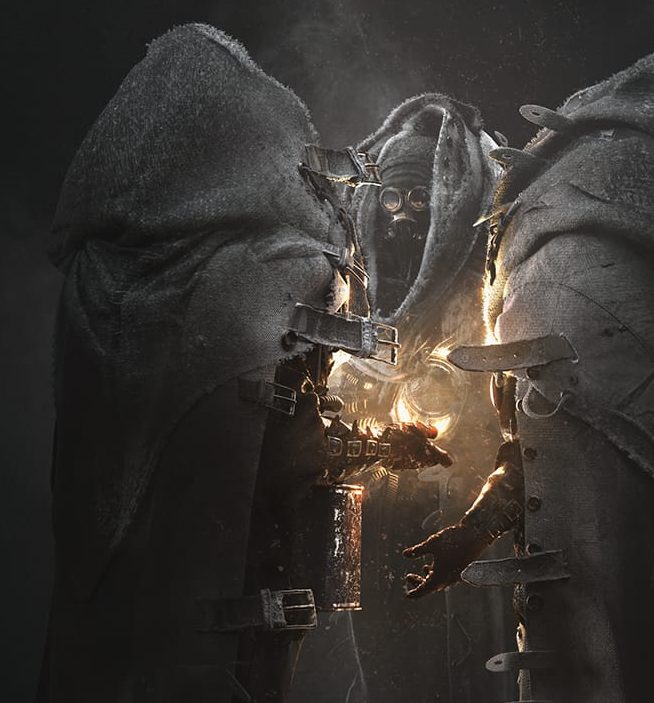
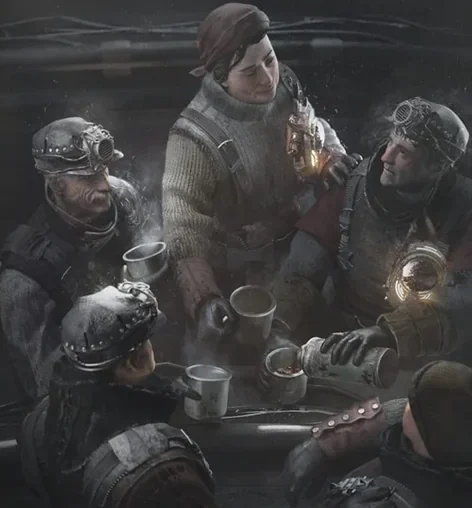
Debriefing is a mandatory part of this experience. Here we will create a space after the game for you and other players to express your feelings and share stories in a serious manner to help you contextualise bleed. As part of this we strongly encourage players engage in positive, out-of-character communication with other players who were part of an intense scene you were a fellow participant in.
Discussing difficult scenes after the fact can help some players to alleviate lasting negative feelings, e.g. “I’m sorry that my character was so cruel to you in-game. Would you like to talk about it?”. Remember that while you might not be suffering negative bleed from an emotional experience, the same is not always certain to be true of other players and you are obligated to ensure the wellbeing of your fellows.
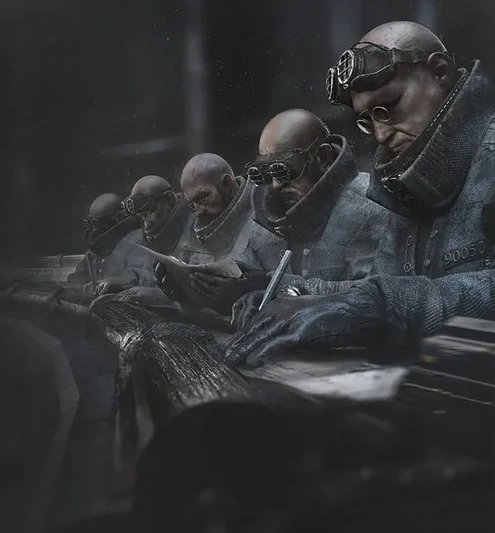
Writing may also be a useful strategy for managing bleed. This can include journaling in- or out-of-character, writing a letter to one’s character, creating new stories around that persona, sharing written game memories with other participants, etc. Tell war stories to each other about your experience. You may find that externalising your experience in a linear fashion, whether verbally or on paper, seems to help immensely by allowing players the chance to reframe their story in a manageable way.
One final strategy after the experience has concluded to help “de-role” is to become immersed in another experience. Often the first 48-hours after a weekend-long game can prove difficult in terms of adjustment. Playing a video game, another role-playing game, or immersing yourself in another fictional reality like a television show can help to ease your transition.
Most importantly, make sure to get an adequate amount of sleep, food and hygiene, this is one of the most vital things to help reset your psychological state to some semblance of normality. Post LARP depression is a common phenomenon and many LARPers often report that the return to the “real world” can feel deflating. Try to set time aside to try and relax in post-game interactions unaffiliated with the game fiction with your fellow players.