How to play
Disclaimer: We will continue playtesting these rules prior to the game starting. As such they are liable to change. Any updates will be included in each website update’s changelogs.
IN Brief
The Frostpunk LARP experience is structured into a Prologue, seven Acts, and an Epilogue. Each Act is separated by a week within the narrative and offers a focused snapshot in time, exploring the evolving stories, relationships, and dynamics between characters. These narrative moments are framed by phases of resource management and world development, which add critical context to your character’s choices and the ongoing struggle to keep the city alive.
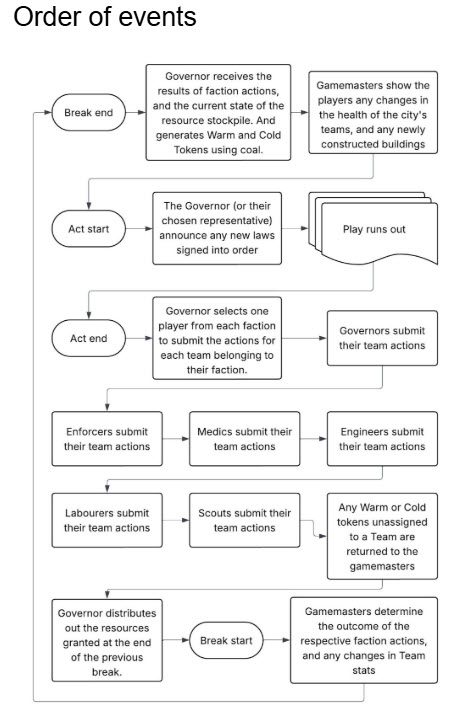
Prior to the beginning of each Act, the Governor will receive a report detailing the outcomes of each faction’s previous actions, including the resources they've gathered. As the Act Progresses, the Governor will have to determine how these resources are best allocated.
At the close of each Act, the Governor will select one representative from each faction to privately submit proposed actions for their teams. Then, the Governor will distribute those resources acquired at the Act’s opening—before learning whether those faction actions succeeded or failed. A more developed step-by-step on the order of events outside of Roleplay can be found at the bottom of this page.
Within this LARP you will be expected to inhabit a character that exists under one of the several broad factions that makeup the city. Within each faction subpage is publicly available information on what actions each faction’s teams can take, what additional activities you might be expected to perform, and in some cases additional items you may begin with.
Live Action Role Play (LARP), is in many ways similar to live action theatre, or a murder mystery party: you step into a character’s shoes and engage with the world as if you are that character, experiencing everything from their point of view. But LARP goes beyond just roleplaying - it demands full creative investment, asking participants to embody their roles in both subtle and dramatic ways.
While there’s usually a loose story structure or a series of key plot points, once you adopt a character, you're not just playing a part—you’re thinking, reacting, and feeling as they would. Their fears become yours, their joys and insecurities, their frustrations and dreams—all lived out during the time you inhabit them. It’s a delicate balancing act: one foot in our reality, the other in the imagined world. And all the while, you’re maintaining safe emotional boundaries to navigate scenes that may involve intense, uncomfortable, or taboo subject matter.
In LARP, you’re in control. You steer your character’s journey—whether it unfolds into something beautiful or harrowing, uplifting or traumatic. This agency allows you to shape and influence powerful narratives, often improvising in ways that go far beyond any written script. When LARP explores themes like horror, desire, or intimacy, it offers a safe space to explore them, supported by systems and mechanics designed to protect players from real harm. Even when a character is suffering, unraveling, or caught in something extreme, the player remains grounded, knowing it’s all part of a shared story being safely told.
In LARP, the focus shifts from describing your actions around a table or navigating a virtual world to physically living the experience. You will don costumes, experience transformed spaces with decoration and props, and bring the story to life through movement, dialogue, and emotional expression. Like actors on a stage, you embody your characters in real-time—making decisions, reacting authentically, and shaping the narrative through direct, visceral engagement.
Frostpunk: The LARP, not only does not require any LARPing experience, and is built with Newbies specifically in mind. The only thing that will be required of you is a dedicated willingness to familiarise yourself with the content laid out in this website and engage with the game to the best of your ability.
Below we will explain how the game will be run, and how the Live Action Roleplay elements of the game will interact with the Resource Management elements which will provide context for the state of the city and your character’s opinion on how it is being managed. You will not be expected to remember all of this solely from reading the website. The Prologue on Friday night will not only serve as an icebreaker, but also provide you the opportunity to familiarise yourself with the rules in a “tutorial-like” environment.
Live Action Roleplay
Props
As part of your roleplay experience, you’ll have access to a variety of props. Please treat all props, the venue, and the property of others with care and respect. Props provided by us will be clearly marked with colored tape to indicate how they can be used:
- Green tape: This prop may be broken at an appropriately dramatic moment, as long as doing so does not pose a risk to yourself or others.
- Amber tape: This prop may be used in ways that could result in damage to the item itself, but not to people, surroundings, or other props.
- Red tape: This prop must not be used in any way that could cause damage.
If a prop is unmarked, do not use it in any manner that might cause damage. Assume that the prop is in fact not a prop but rather property of the venue. If any item unmarked by tape is damaged we may hold you responsible for compensating the venue accordingly.
Some props are specialist items with unique functions that can dramatically alter the narrative or even be "lethal" to other characters. Unless otherwise specified, these items are limited to one use per item per act. Players will be informed when they come into the ownership of such an item.
The following are considered specialist items, click each to find out more:











Alcohol
Alcohol will be inaccessible during play until the Public House law is signed and constructed. Gamemasters will closely monitor the alcohol stash, and for the sake of the game’s integrity, players are strongly discouraged from attempting to steal it or smuggle in their own supplies. That said… some characters may come into possession of hip flasks as the story unfolds.
Violence
As mentioned earlier, certain items can instantly result in a character’s death. However, not all physical confrontations are lethal, and those with violent intent aren't limited to firearms and blades.
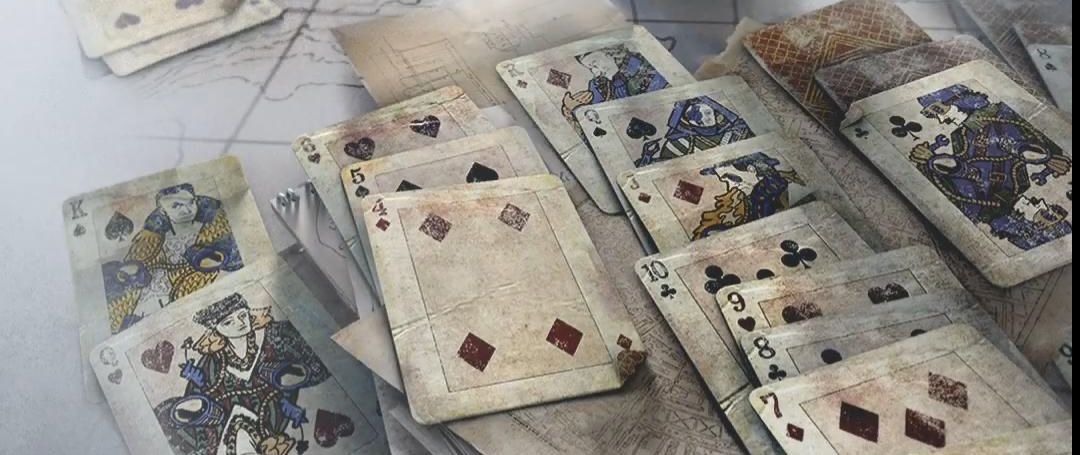
When two or more characters engage in physical conflict intending to harm one another, a card draw system will be used to resolve the outcome. At the start of play, each player will receive a sealed envelope containing a card numbered 1 to 10. If a fight breaks out, a player may declare their intent to “draw cards.” Once this declaration is made, any opportunity to use an item for advantage is lost—your opponent has taken the initiative, rushing in with fists, pipes, or wrenches before you can react.

Before drawing, every participant must clearly state their intended objective (e.g., “I want to kill this character,” “I want to knock them out,” “I want to restrain them,” or “I want to escape”). All players then draw their cards. The higher card wins and their stated objective is successful. If the highest cards drawn are equal, the players in question must negotiate the outcome: either their respective objectives succeed, or—if that isn’t feasible—none do. If no agreement can be reached, the players must consult a gamemaster and receive new cards. In any case, once cards have been drawn, every player involved must return to the gamemaster as early as possible without compromising the narrative impact of their scene, and be given a new card envelope. This excludes any characters who have perished as a result of the violence and therefore will be provided with a new card for their next character anyway.
If you and another player would like to enact a violent scene—either after a card draw or as a pre-planned moment—you may do so, provided both parties explicitly consent and all physical contact adheres to the guidelines outlined in the Safety Tools section.
If a card draw is declared but one player prefers for their character to lose—whether to “play to lose,” or simply to serve the story—they may choose to forfeit. In that case, no cards are drawn, and their opponent’s objective succeeds.
Death
In Frostpunk, character death is a likely outcome for any character and may come about from innumerable causes including violence, disease, and starvation. When your character dies, whether they are killed or simply expire from a failure of their basic needs being met, aim to die in a timely manner. You may take a moment for final words - whether to nearby characters or into the void - but avoid lingering so long that another player spends ten minutes searching the entire venue, only to find you still dramatically expiring. If you die during an Act, you are expected to remain as a corpse at least until your body is discovered.
Once your tenure as a corpse is concluded, you will return as one of your two prepared backup characters as decided by the gamemasters. As neither of your backup characters will lack the same depth of relationship that comes from a shared development in the workshop, you will instead be provided with several additional tools to assist you in assimilating into the story quickly and easily:
First, gamemasters may provide you with a small piece of information that your character is aware of. This could be a secret, a mystery or blackmail on another character. This ensures that your new character will have plot to immediately involve themselves in that guarantees an immediate “in” with at least one other player character. If you find that your plot has a new character interjecting that you had not previously anticipated, please show sportsmanship and be welcoming to their intrusion (at least out of character), after all, they did die only recently.
Second, gamemasters will have a set of prompt cards designed to inspire possible connections between characters. These cards suggest shared, untold histories—perhaps your character was once a student of an Engineer or Medic before the frost, fought alongside an Enforcer in a past battle, or helped a Scout in a moment of crisis. Using a prompt card is entirely optional, and you’re free to create your own backstory connections with others. If you’d like to explore a prior connection, simply use the “Off-game” safety tool to initiate a conversation to check with another player to see if they’re interested, and move the conversation to the out of character area to rapidly hammer out any details.
NOTE: Character death will not be possible in the prologue, and killing others will be forbidden
The People of The CIty
Teams
The City is divided into seven distinct “factions”, each representing different worker groups and demographics within the population. Each Faction is made up of a number of teams, and every team has three factors that indicate their current condition: Hunger, Shelter, and Health. As hunger and cold increases, the risk of becoming sick—and eventually gravely ill—also rises. If a gravely ill faction's condition worsens further, they will die. As the Governor is ultimately responsible for deciding the allocation of precious resources like food, shelter and warmth, they are the final arbiter of the wellbeing of the people you are responsible for.
Actions
Nearly every team within the city will have the ability to undertake specific actions, which are detailed on their Faction’s page and displayed on their Faction Board during play. These actions are submitted at the end of each Act, typically by a representative chosen by the Governor. However, under certain conditions, a faction may appoint its own leader to submit actions on behalf of their teams (see Faction Leadership for more details).
All team actions are submitted privately to the Gamemasters and must not be shown to any other players. That said, there’s no rule against telling others what was submitted—though whether that information is true, or whether you can trust the person saying it, is another matter entirely.
Only the Governor will see the results of these actions, reflected in the resources gathered before the start of the next Act. No other characters will know whether a team’s actions succeeded or failed.
Some Actions will require consuming resources from the stockpile such as wood and steel. As only the Governor knows the number of units stockpiled of any given resource, some teams may end up attempting actions without the necessary resources to do so. In this case the action automatically fails.
Hunger
There are six possible hunger conditions a team can experience, ranging from best to worst: Well Fed, Fed, Hungry, Famished, Starving, and Malnourished.
Teams that are Well Fed gain a small health bonus, while Fed teams receive neither bonuses nor penalties. Starting from Hungry and worsening from there, teams begin to suffer increasing health penalties, which grow more severe the hungrier they become. No team can fall below the Malnourished condition.
Each time a team is fed at the cost of a unit of food, their current hunger condition remains the same. Feeding the team an additional unit of food improves their condition by one while leaving a team unfed causes them to drop a tier. A team cannot be fed more than two units of food at the end of any single act.
Shelter
There are three possible shelter conditions a team can be in, ranked from best to worst: House, Tent, and Homeless.
Teams living in a House receive a minor Health bonus, while those in Tents gain a smaller bonus. Homeless teams receive minor penalties, and their lack of shelter is likely to affect in-character morale.
Warmth
At the very start of each Act, the Governor must decide how much coal to feed the Generator. The amount of Coal fed into the generator, combined with its Efficiency, produces a value. From this value, the current cold level multiplied by the number of teams in play is subtracted. The result is known as the Heat Budget, which will provide a number of Warm Tokens if positive and a number of Cold Tokens if negative.
Warm Tokens provide a positive health bonus to any team they are assigned to, whilst Cold Tokens create a health penalty. Multiple tokens of either type can be stacked on one team, meaning a canny governor can prioritise the health of certain teams by prioritising their warmth over others.
Warm and Cold Tokens cancel each other out on a 1-to-1 basis. Therefore, the Governor may choose to add additional Warm Tokens to their pool by adding an equal number of Cold Tokens to their pool. This allows the Governor to prioritise heat for teams considered vital to the city's survival—at the cost of those deemed less essential.
No single team can have more than 20 of either token allocated to them in a given act.
Health
After the Governor has finished distributing resources at the end of an Act, each team's Shelter, Hunger, and Warmth levels are used to determine their chance of a health decline.
Teams that are well fed, warm, and sheltered will have a low—or even zero—chance of becoming more ill. In contrast, teams that are hungry, cold, and without shelter face a much higher risk of dropping one level on the Health track—or even two, if their conditions are especially dire.
Teams that are ill or gravely ill have a minor chance of failing whatever action they’ve been assigned at the end of an act. If a team fails an action which had an associated resource cost, those resources are not consumed and are refunded at the beginning of the next act.

Generating Tokens
While the generator is the primary source of Warm Tokens, there are additional ways to earn both Warm and Cold Tokens throughout the LARP. These are typically gained by completing specific activities or participating in certain events. How you choose to use these Tokens is entirely up to you—they can be assigned to teams within your own faction or given to teams from other factions at your discretion.
Warm Tokens may also function as a form of currency for trades, while Cold Tokens can serve as a means of applying pressure or issuing threats to rival factions. Additionally, the Governor has the authority to enact laws permitting the seizure of Tokens.
No tokens can be banked or carried over between Acts, all tokens must be expended by the end of each Act. Any Warm tokens not assigned to a team by the end of an act expire. Any Cold tokens not assigned to a team by the end of an act are assigned to the teams belonging to the faction of the holder. Tokens cannot be assigned to Automatons. Once a Token has been assigned to a team it cannot be moved or reassigned unless explicitly stated otherwise within a rule or team action.
Resource Management
There are four essential resources critical to the city's survival, each with its own distinct role:
- Wood is a fundamental construction material used in building projects, including housing and Automatons.
- Steel is needed for more advanced constructions, such as improving Generator Efficiency, and enhancing medical facilities.
- Coal powers the Generator—without it, there’s no heat, and without heat, the city freezes.
- Food sustains your people. Starving citizens are more likely to fall ill, and a city without its people is no city at all.
The use of Food and Coal has already been described above, within the “Teams” section. Wood and Steel is instead used directly by factions, and can be found in the faction subpages. Any of these resources can be stockpiled and are not perishable.
Synchronicity Between Characters and Teams
While it's understood that the city’s population is represented by various teams, the specific team affiliation of any individual Player Character is intentionally left vague. These teams and their actions occur off-screen, between Acts, meaning that while your character oversees or represents your faction’s teams, they are not considered a member of any one team directly.
However, this can stretch believability—especially when the teams under a faction begin to suffer due to unmet basic needs, while Player Characters appear unaffected.
To address this, it’s assumed that a Player Character mirrors the condition of the most well-off team in their faction for each key status: hunger, health, and shelter. For example, if one team in your faction is well fed, one is housed, and another is healthy, you may assume your character shares those same positive conditions. Conversely, if all teams are starving, homeless, and sick, your character should reflect that hardship as well.
Importantly, these conditions carry no mechanical or meta-game consequences. No attendee will be denied food or comfort based on their faction’s in-game status. Instead, these abstract states are intended to guide your roleplay—offering opportunities to portray your character’s wellbeing (or lack thereof) and to enrich your interactions with others.
Faction Leadership
At any point during an Act—after it begins and before it ends—any faction with three or more members may vote to elect a Faction Leader from among their own ranks. Once elected, the Faction Leader has the authority to choose the team actions for their faction at the end of the Act, overruling any Governor’s appointed leader.
This leadership remains in effect until one of the following occurs:
- The Faction votes to remove or replace the leader
- The Leader is killed or otherwise removed from play
- The Governor passes a law prohibiting the faction from electing its own leader
Order of Events